Mood Board or Rendering? What Each One Actually Tells You
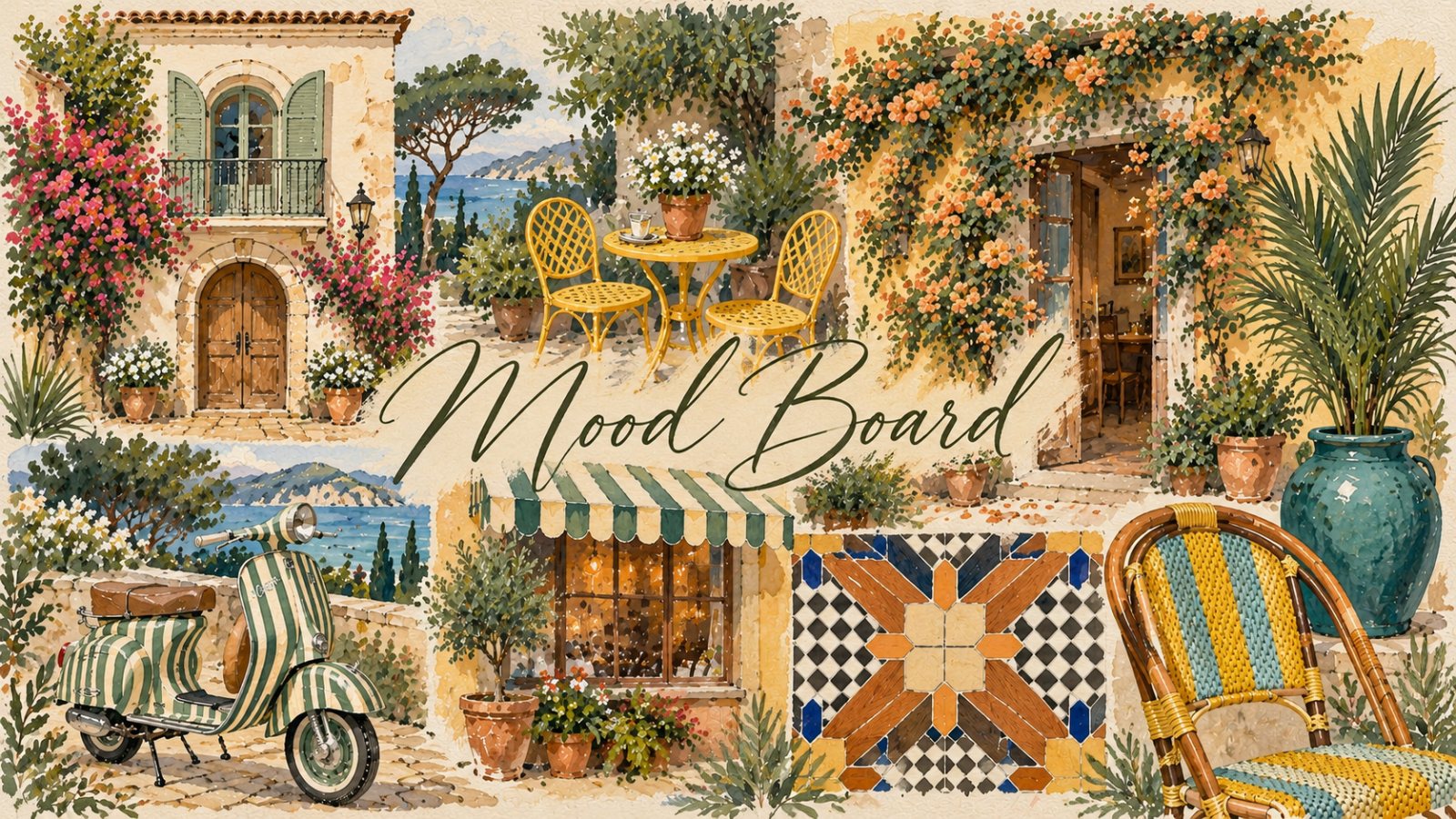
A mood board tells you how a room will feel. A rendering tells you how it will look. Neither one tells you whether it will work — that is the floor plan’s job, and it is the document most people skip past fastest.
Understanding the difference matters more than it sounds, because the single most expensive mistake in a design project is approving the wrong document for the wrong reason.
Mood board vs rendering, in plain terms
A mood board is a collection of references — colors, materials, fabrics, a chair, a photograph of light falling a certain way. It is not a picture of your room. It is a picture of the intention for your room.
A rendering is a three-dimensional model of your actual space, with your actual dimensions, furnished and lit. It looks like a photograph of a room that does not exist yet.
People assume the rendering is the more advanced document, and therefore the more important one. It is the more finished document. That is not the same thing.
What each one is actually for
| Mood board | Rendering | Floor plan | |
| Answers | How will this feel? | How will this look? | Will this work? |
| Shows | Palette, materials, mood, direction | Scale, sightlines, the finished room | Movement, clearances, adjacencies |
| Cannot tell you | Whether anything fits | How the materials feel in hand | How any of it looks |
| You see it | Early, before spending | After the plan is settled | Before either of the others matter |
| Change costs | Nothing | Hours | Everything, if changed late |
The mistake that costs the most
It is approving a rendering as though it were a plan.
A rendering is persuasive. It is lit beautifully, shot from the one angle that flatters the room, and styled with objects nobody owns. It is very easy to look at one, feel pleased, and sign off — without noticing that the walkway behind the sofa is twenty-six inches wide, or that the only path to the garden now runs between the coffee table and the fireplace.
Renderings answer an aesthetic question extremely well and a spatial question badly, because they show you one frozen viewpoint of a space you will move through. Look at the plan for whether it works. Look at the rendering for whether you like it. In that order.
The mistake that costs the second most
Rejecting a mood board because of one item on it.
A mood board is a direction, not a shopping list. The specific chair on it is frequently not the chair that ends up in the room — it is there to say this proportion, this weight, this attitude. When a client says “I don’t like that chair,” a good designer hears a question: is it the shape, the color, the formality, or the chair itself? The answer sends the whole project in a different direction, and it is worth getting right.
How to review a mood board well
The most useful feedback is about feeling, not objects. Three questions get you most of the way:
What is the first word that comes to mind? Say it before you edit yourself. “Cold,” “grand,” “busy,” “safe” — all of these are more useful than “nice.”
What is missing? Often the issue is not what is on the board but what isn’t. No warmth. Nothing of yours. Nothing that would survive a child.
Which single element would you remove? This surfaces the thing you are quietly uneasy about, which is usually the thing worth discussing.
What is least useful is approving everything. A mood board that gets a flat yes has either nailed it or not been looked at properly, and designers cannot tell the difference.
How to review a rendering well
Ignore the styling. The books, the flowers, the bowl of lemons — none of it is being proposed. Look instead at the proportions of the large objects, the height of things on the walls, where the light comes from, and what you would reach for if you sat down. Ask for a second viewpoint from the doorway, because that is how you will actually meet the room every day.
Common questions
Do I need both a mood board and a rendering?
For a single room with a settled layout, often not — a mood board, a plan and elevations are enough. For a renovation, a build, or any space where you cannot picture the finished volume, a rendering earns its cost by catching problems while they are still free to fix.
Are renderings accurate?
Geometrically, yes — they are built from real dimensions. Materially, they are an approximation: the way light moves across a real stone or a real velvet is beyond what most renderings capture. Always ask to handle the actual samples, whatever the rendering shows.
How many revisions should I expect?
Two rounds is normal and healthy. More than three usually means something was not resolved at the earlier stage, and the honest fix is to go back a step rather than keep adjusting the image.
Can I make my own mood board before hiring someone?
Yes, and it helps enormously — not because a designer will build from it, but because what you collect reveals patterns you did not know you had. Bring it to the first conversation.
Why does my mood board look nothing like the final room?
Because it was never meant to. If the room feels the way the board felt, the board did its job. A room that matched its mood board literally would be a collage, not a home.
Where this sits in our process
In our work, the spatial decisions come first and the sensory layer comes second — plan, adjacencies and sightlines before palettes, materials and styling. You can read how that is structured stage by stage, or, if you are still deciding whether to bring someone in at all, start with how to know if you are ready.